
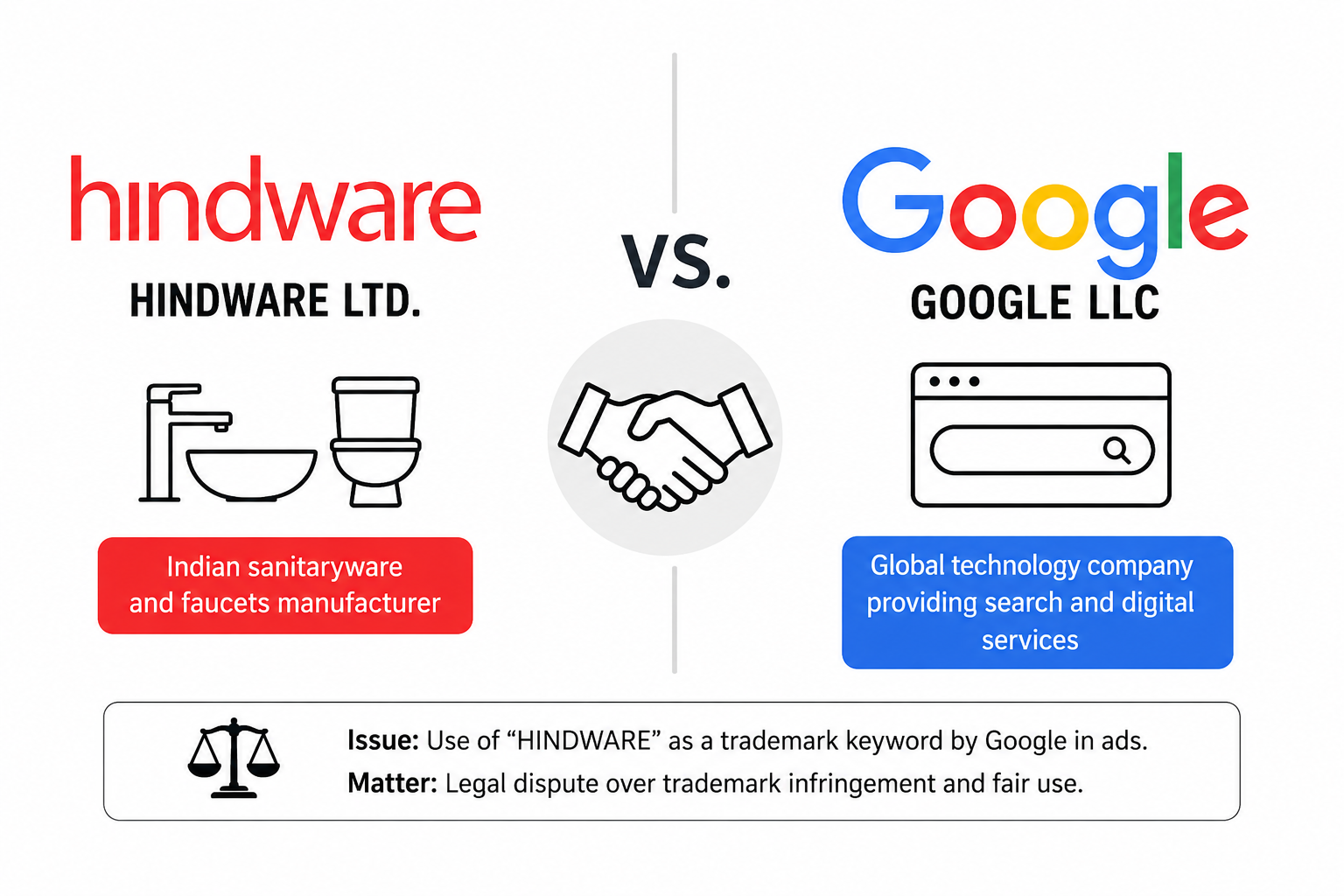
HINDWARE LTD. VERSUS GOOGLE LLC
Delhi High Court | 22 May 2026 | Justice Mini Pushkarna
CS(COMM) 591/2017 • 2026 LLBiz HC (DEL) 541
You Typed “HINDWARE” on Google.
A Competitor’s Ad Appeared.
The Delhi High Court Says That’s Trademark Infringement.
In a landmark judgment, the Delhi High Court has held that using someone else’s trademark as a Google Ads keyword can amount to trademark infringement, even if that trademark is never visible to the public.
The decision was delivered by Justice Mini Pushkarna in a 163-page judgment in Hindware Ltd. v. Google LLC (2026). The Court not only held the advertisers liable but also found Google responsible for its role in facilitating the practice.
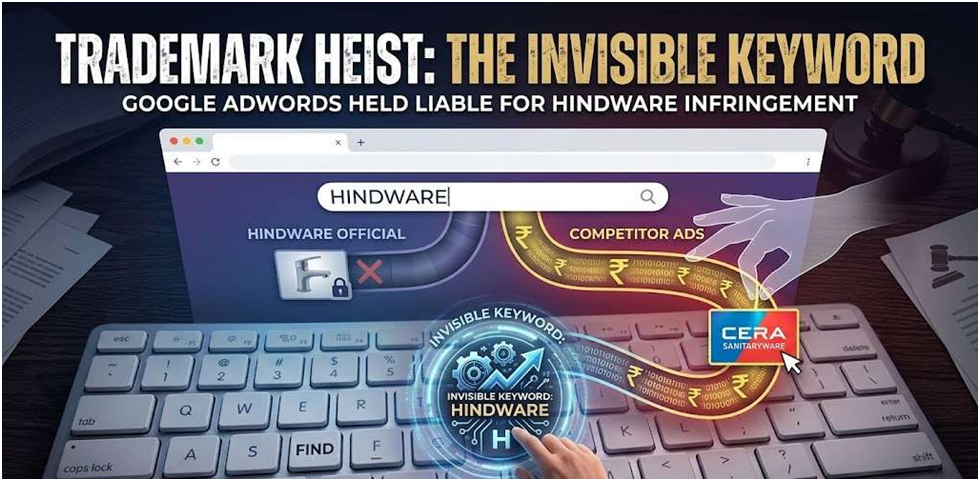
Imagine you search for “HINDWARE”on Google because you want to buy Hindware products.
Instead of seeingHindwarefirst, youare shownan advertisement fora competingbrand like Cera or Grohe. The word “HINDWARE” may not appear anywhere in that advertisement. However, the competitor had secretly purchased the keyword “HINDWARE” through Google Ads so that its advertisement would appear whenever users searched for Hindware. According to the Court, this allows competitors to benefit from the goodwill and reputation built by Hindware over many years.
The Court held that this amounts to trademark infringement.
“Invisible use of a trademark to divert traffic from the proprietor’s website to the advertiser’s website shall amount to use of the mark for the purpose of Section 29.”
— Justice Mini Pushkarna
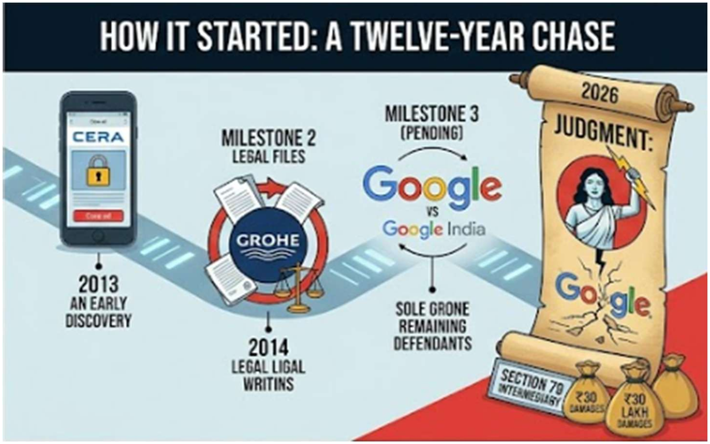
In 2013, HSIL Limited (now Hindware) discovered that competitors were purchasing the following keywords through Google Ads:
- HINDWARE
- HINDWARE SANITARY
- HINDWARE SANITARYWARE
As a result, advertisements of competing brands appeared whenever consumers searched for Hindware.
Hindware filed a trademark infringement suit.
In 2014, Hindware discovered that Grohe India was also using similar keyword advertising practices and filed another suit.
During the litigation, the competing advertisers eventually settled with Hindware and exited the case.
Google remained the only contesting defendant.
Google argued:
- A keyword is invisible and therefore cannot amount to trademark use.
- Google is merely a platform and should be protected as an intermediary under Section 79 of the Information Technology Act.
ON 22 May 2026, the Delhi High Court rejected both arguments.
The Court granted a permanent injunction against Google and awarded Hindware ₹30 lakh in damages.
QUESTION 1: Is an Invisible Keyword a Trademark Use?
Google argued that trademark infringement requires the trademark to be visible to consumers. Since users never see the keyword stored in Google’s backend system, Google claimed there was no trademark use.
The Court disagreed. According to the Court, the real issue is not visibility but commercial exploitation. If a competitor uses the trademark “HINDWARE” to attract customers searching specifically for Hindware products, it is taking advantage of Hindware’s reputation. Whether consumers can see the keyword or not makes no difference.
The Court observed that invisibility does not make the conduct lawful. If anything, it simply makes the practice harder to detect.
QUESTION 2: Can Google Claim Safe Harbour Protection?
Google relied on Section 79 of the Information Technology Act, which protects intermediaries from liability for content created by third parties.
- Advertisers choose the keywords.
- Advertisers create the advertisements.
- Google only provides the platform.
The Court examined Google’s actual role and found that Google was much more than a passive platform.
- Provides keyword suggestion tools.
- Recommends search terms, including trademarks.
- Conducts keyword auctions.
- Decides which advertisements appear.
- Earns money every time users click on those advertisements
Because Google actively participates in the advertising process and profits from it, the Court held that Google could not simply call itself a neutral intermediary.
The Court therefore denied Google the protection of Section 79.
— Justice Mini Pushkarna
| ➜ Provides a Keyword Planner tool that actively suggests trademarked terms to advertisers |
| ➜ Recommends search terms, including competitors’ trademarks |
| ➜ Conducts real-time keyword auctions |
| ➜ Decides which advertisements appear in response to searches |
| ➜ Earns pay-per-click revenue every time a user clicks on a competitor’s ad |
— Justice Mini Pushkarna
The Court permanently restrained Google from allowing the use of:
- HINDWARE
- HINDWARE SANITARYWARE
- HINDWARE SANITARY
- HINDWARE SANITARYWARE INDIA
and similar variations as advertising keywords.
The Court also awarded Hindware ₹30 lakh in damages.
The relatively modest damages were due to limited evidence of actual monetary loss, not because the infringement was considered minor.
This decision could significantly change how digital advertising operates in India.
The judgment means:
Trademark owners can sue both:
- The competitor buying the keyword; and
- The platform facilitating the keyword advertising.
Invisible use is no defence
A trademark does not need to be visible to be infringed.
Intermediary protection is not automatic
Platforms may lose safe harbour protection if they actively participate in or profit from infringing activity.
Brand owners gain stronger rights
Companies may now rely on this judgment to ask Google to restrict competitors from bidding on their registered trademarks.
THE BIGGER TAKEAWAY
A business cannot take advantage of another company’s reputation merely because the mechanism is hidden behind technology. Whether the trademark is used on a shop sign, on product packaging, or as an invisible keyword inside a search engine, the goodwill belongs to the trademark owner.
The legal position is still likely to be tested before a Division Bench or the Supreme Court. However, as of today, the Hindware judgment is the strongest Indian precedent on competitor keyword advertising.