

1. What’s Changed?
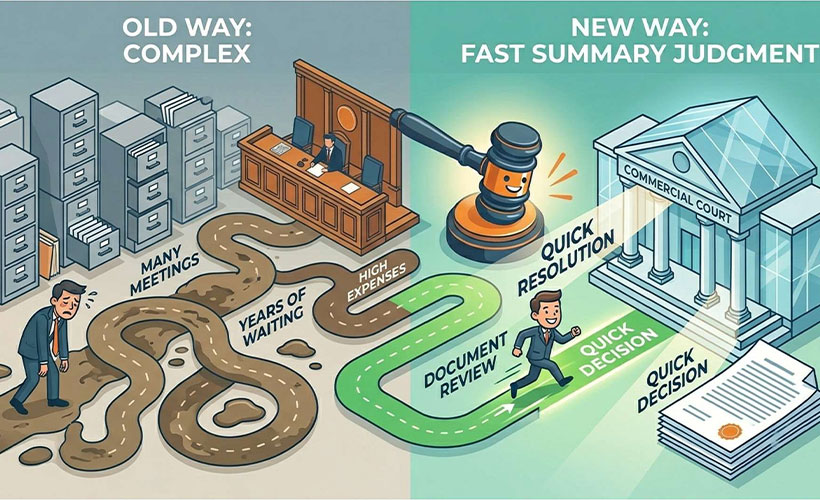
For a long time, commercial litigation in India followed a lengthy process. Once a dispute was filed before the court, the matter usually went through pleadings, evidence, witness examination, and final arguments before a judgment could be delivered. Even when the dispute was straightforward and supported by strong documents, parties still had to undergo a complete trial.
This situation changed after the introduction of Order XIII-A under the Commercial Courts Act, 2015. Courts are now empowered to examine commercial disputes at an early stage and determine whether a full trial is actually necessary.
Today, courts focus on an important question:
Is there a genuine issue requiring trial, or is the dispute unnecessarily being prolonged?
If the available documents and records are sufficient to decide the case, courts can now pass judgment without waiting for a full trial.
2. The Rule in Simple Terms
Summary judgment is based on the principle of judicial efficiency and speedy dispute resolution.
A court can dispose of a commercial dispute early if:
- One party has no real chance of succeeding in the case, and
- There is no compelling reason to continue with a full trial.
The phrase “no real prospect” means that the claim or defence lacks proper legal or factual support. Even if a full trial takes place, the result is unlikely to change.
Courts also examine whether oral evidence is genuinely required. If the dispute can be resolved through documents, admissions, and undisputed records, continuing the trial becomes unnecessary.
In simple words, when the outcome is already clear from the available material, the law does not require courts to waste time on a lengthy trial.
3. What the Supreme Court Says
The Supreme Court has clarified the proper use of summary judgment in commercial disputes.
According to the Court:
- Summary judgment should not replace every trial.
- Courts should avoid unnecessary delay where lack of merit is obvious.
- Judges should not conduct detailed evidence analysis at this stage.
- Defences must be supported by proper material and not by vague allegations.
The judiciary has emphasized that courts must balance caution with decisiveness. Where a dispute is not genuinely triable, courts are expected to conclude the matter early instead of allowing procedural delays.
4. How Courts Have Actually Used It
Indian courts have actively used summary judgment in commercial and intellectual property disputes where documents clearly established the facts.
Counterfeit Trademark Cases
In several trademark disputes, courts granted immediate injunctions when counterfeit goods were discovered and defendants admitted that the products were fake. Since the facts were already clear, courts found no reason to continue with a trial.
Non-Appearance by Defendants
Courts have also passed judgments quickly where defendants failed to appear before the court or refused to participate in proceedings. In such situations, plaintiffs’ documents remained uncontested, allowing courts to decide the dispute without delay.
Technical and Software Disputes
In some software and copyright disputes, defendants submitted expert reports proving that no copying had taken place. Where the technical evidence clearly disproved the plaintiff’s allegations, courts dismissed the suit at an early stage itself.
Complex Commercial Disputes
Even in complicated commercial disputes involving trademarks, ownership rights, and contractual issues, courts have passed summary judgments where agreements and records already provided a clear answer.
This shows an important judicial shift.
Earlier, courts focused on how complicated a dispute appeared. Today, courts focus on whether the existing material already resolves the dispute.
5. When It Will NOT Apply
Despite its usefulness, summary judgment cannot be applied in every commercial dispute.
Courts usually refuse summary judgment where:
- Serious factual disputes exist
- Witness credibility becomes important
- Oral evidence is necessary
- Technical issues require detailed expert examination
- Documents are incomplete or disputed
For example, cases involving fraud, complex financial calculations, or heavily disputed contractual obligations generally require a full trial.
The guiding principle remains simple:
If proper adjudication depends on detailed evidence examination, a full trial becomes necessary.
6. What This Means for You
The increasing use of summary judgment has changed litigation strategy in commercial disputes.
For Plaintiffs
Plaintiffs must now focus on:
- Strong documentation
- Early legal preparation
- Clear evidence from the beginning
A properly supported claim may result in quick relief without years of litigation.
For Defendants
Defendants can no longer rely on delay tactics or vague denials.
Courts now expect:
- Specific responses
- Proper supporting documents
- Genuine defences supported by material evidence
Weak or unsupported defences may be rejected at the threshold stage itself.
7. Conclusion
Summary judgment has significantly transformed commercial litigation in India.
Courts are increasingly willing to decide disputes at an early stage where documents and records already provide a clear answer. This has reduced unnecessary trials and improved judicial efficiency.
The practical impact is substantial:
- Strong cases are resolved faster
- Weak defences are filtered out early
- Litigation has become more focused and efficient
The biggest conceptual shift is that finality is no longer reserved only for the end of a lengthy trial.
In many commercial disputes today, the outcome can be determined right at the beginning of the proceedings itself.