
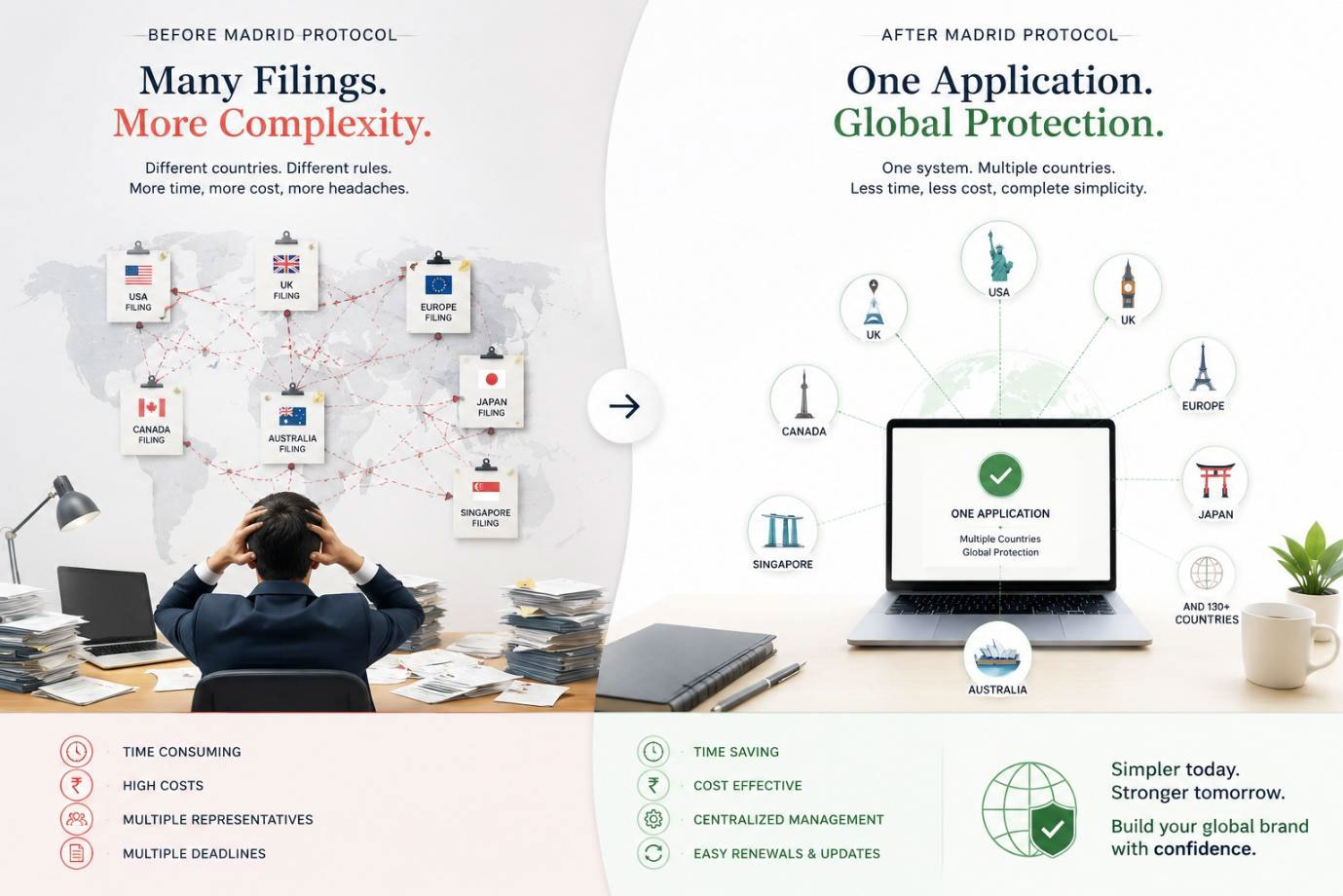
Expanding into international markets is exciting. Managing trademark filings across multiple countries? Not so much.
For businesses looking to protect their brands beyond India, the traditional route often meant filing separate trademark applications in every country of interest – each with its own procedures, timelines, fees, and legal requirements. As businesses expanded, so did the complexity of managing their trademark portfolio.
The Madrid Protocol was designed to change that.
Administered by the World Intellectual Property Organization (WIPO), the Madrid System allows trademark owners to seek protection in multiple member countries through a single international application. Instead of juggling numerous filings across jurisdictions, businesses can use a centralized system to manage their international trademark strategy more efficiently.
Since India joined the Madrid Protocol in 2013, Indian businesses have increasingly used this mechanism to simplify international trademark filings and support global expansion.
But how does the Madrid System actually work, who can use it, and is it always the right choice? Let’s break it down.
I. ONE APPLICATION, MULTIPLE COUNTRIES: WHY BUSINESSES ARE CHOOSING THE MADRID ROUTE
One of the biggest advantages of the Madrid Protocol is convenience.
Traditionally, businesses seeking trademark protection in multiple countries had to file separate applications, comply with different legal requirements, and often appoint local representatives in each jurisdiction.
The Madrid System simplifies this process by allowing applicants to:
1. File One Application
Submit a single international application through the home trademark office instead of filing multiple separate applications.
2. Choose Multiple Countries
Designate several member countries in one application and add more countries later as your business grows.
3. Reduce Administrative Burden
Manage changes such as ownership, address, or name centrally instead of updating records in every country.
4. Streamline Renewals
Handle international trademark renewals through one centralized system.
5. Potentially Reduce Costs
The Madrid System is often more cost-effective than filing separate applications in multiple jurisdictions.
II. NOT EVERY TRADEMARK CAN GO GLOBAL – HERE’S WHAT YOU NEED FIRST
Not every trademark owner can immediately file an international application.
For Indian applicants, a basic trademark application or registration in India is mandatory. The international application must be based on that Indian application or registration.
Businesses should therefore ensure their trademark in India is properly secured before seeking international protection.
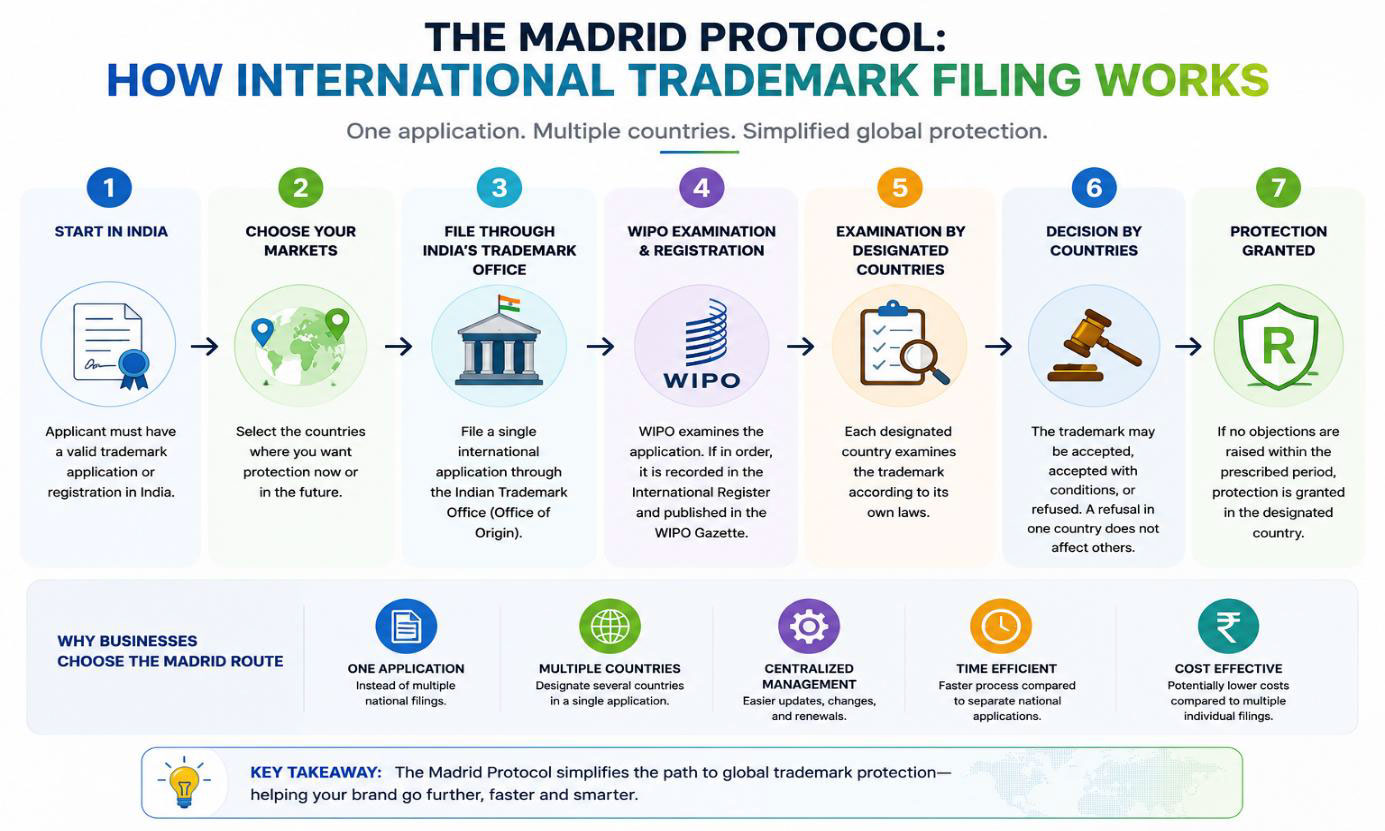
How Does a Madrid Filing Actually Work?
While the Madrid Protocol simplifies international trademark protection, the process still follows a structured route. Here’s what happens after you decide to seek protection through the Madrid System.
Step 1: Start with a Trademark in India
Before filing internationally, the applicant must have a corresponding trademark application or registration in India.
The international application must be based on the same trademark and cover identical or narrower goods and services.
Step 2: Choose Your Markets Wisely
Businesses should carefully assess current and future markets before selecting countries.
Common considerations include:
- Export destinations
- Manufacturing locations
- Franchise expansion plans
- E-commerce markets
- Future business growth opportunities
Step 3: Preparing Your International Application
The application typically includes:
- Applicant details
- Trademark representation
- Goods and services description
- Details of the Indian application or registration
- Designated countries
Step 4: Filing Through India’s Trademark Office
The application is filed through the Indian Trademark Office, which acts as the Office of Origin. The Registry verifies that the international application matches the Indian trademark application or registration.
Step 5: WIPO Steps In
WIPO reviews the application for procedural compliance. If approved, the trademark is recorded in the International Register and published in the WIPO Gazette.
Step 6: Examination by Designated Countries
Each designated country examines the trademark under its own laws. The application may be:
- Accepted
- Accepted with conditions
- Refused
A refusal in one country does not affect protection in other designated countries.
Step 7: Grant of Protection
If no objection is raised within the prescribed period, protection is granted in the designated country, where the trademark enjoys the same protection as a nationally registered mark.
III. THE CATCH MOST BUSINESSES DON’T KNOW ABOUT
One aspect of the Madrid Protocol that businesses often overlook is the so-called “Central Attack” principle.
For the first five years, the international registration remains dependent on the Indian trademark application or registration on which it is based.
What This Looks Like in Practice
If your Indian trademark is refused, withdrawn, cancelled, or successfully challenged during the first five years, every country designated through the Madrid System can also be affected, even if those countries have already accepted your trademark.
After five years, the international registration becomes independent of the Indian trademark.
The takeaway: Ensure your Indian trademark is strong before expanding internationally. A weak foundation at home can put your entire global trademark portfolio at risk.
IV. HOW LONG DOES THE PROCESS TAKE?
The timeline depends on the countries selected.
Generally:
- WIPO examination may take a few weeks to a few months.
- Designated countries usually have 12 to 18 months to communicate objections or refusals.
In many cases, protection can be secured much faster than filing separate national applications.
V. SHOULD EVERY BUSINESS CHOOSE THE MADRID ROUTE?
Not necessarily. While the Madrid Protocol offers significant advantages, every business has different commercial objectives.
Businesses seeking protection in only a few countries may prefer direct national filings, while those planning broader international expansion can benefit from the Madrid System’s centralized and cost-effective approach.
The best strategy depends on factors such as target markets, expansion plans, business needs, budget, and the existing trademark portfolio.
VI. CONCLUSION
As businesses continue to expand globally, protecting a trademark only in India is no longer enough.
The Madrid Protocol has transformed international trademark protection by offering a centralized, efficient system built for global growth. However, success still depends on careful planning and a strong trademark strategy.
The practical impact:
- One filing instead of many
- Centralized renewals and updates
- Faster, more cost-effective international expansion
- The flexibility to add countries as you grow
In today’s borderless marketplace, the question isn’t whether to protect your brand internationally – it’s how soon.