
1. Introduction
As businesses expand beyond India, one issue becomes extremely important — trademark protection outside India.
Many businesses assume that once a trademark is registered in India, it automatically receives protection internationally. However, trademark rights are territorial in nature. A trademark registered in India only provides protection within India.
The moment a business starts exporting products, advertising internationally, or gaining overseas visibility, the brand becomes exposed in countries where it has no trademark protection.
This issue is very common in international business expansion. Companies often discover that their trademark has already been registered abroad by another party, sometimes even by distributors or unrelated third parties. In such situations, the original owner may face legal disputes in foreign countries and may struggle to protect its brand.
That is why international trademark protection should be treated as an important part of business planning rather than an afterthought.
2. There Is No Global Trademark
One of the most important things businesses must understand is that there is no single trademark registration that provides worldwide protection.
No international authority grants universal trademark rights.
Trademark protection must always be secured country by country because each jurisdiction has its own trademark laws and legal standards.
Although international filing systems exist, they only simplify the filing process. They do not replace domestic trademark laws. Every country independently decides whether a trademark application should be accepted or refused.
Therefore, businesses seeking international expansion must carefully identify the countries where trademark protection is required.
3. How to File Trademarks Internationally
Businesses generally have two options for obtaining trademark protection outside India:
- Direct filing in individual countries
- Filing through the Madrid System
Both methods are legally valid, and the choice depends on the business strategy, budget, and countries involved.
4. Direct Filings
Direct filing means submitting trademark applications separately in each country through local trademark attorneys or agents.
This approach offers greater flexibility because businesses can:
- Adapt applications according to local legal requirements
- Customize specifications for goods and services
- Handle country-specific issues more effectively
In certain jurisdictions, direct filing may even be the only practical option.
However, direct filing also has disadvantages:
- Multiple applications must be filed
- Different local agents are required
- Costs become higher
- Timelines vary across countries
- Managing filings becomes more complicated
Despite these challenges, direct filing is often preferred in sensitive or disputed matters because it provides greater control over the application process.
5. The Madrid System
The Madrid System is an international trademark filing system administered by the World Intellectual Property Organization (WIPO).
Under this system, a business can file a single international application through the Indian Trade Marks Registry and designate the countries where protection is required.
The Madrid System simplifies the filing process because businesses do not need to file separate applications initially in every country.
However, the process still requires careful handling.
The international application must be based on an existing Indian trademark application or registration. The trademark and list of goods or services in the international application must match the Indian application.
Once submitted, WIPO conducts a formal examination and forwards the application to the selected countries.
After that stage, each country independently examines the trademark according to its domestic law.
If objections arise in any country, they must be handled separately under that country’s legal system, usually through local attorneys.
Therefore, while filing is centralized, the examination process remains country-specific.
6. Common Mistakes
Many businesses misunderstand the Madrid System and assume it guarantees automatic worldwide protection. In reality, it only simplifies filing and does not ensure approval in every jurisdiction.
Another common mistake is filing internationally before securing a strong trademark position in India.
For the first five years, international registrations under the Madrid System remain dependent on the Indian trademark application or registration. If the Indian trademark fails, the international registration may also collapse.
Businesses also frequently skip trademark clearance searches before filing internationally. This creates problems because a trademark that is acceptable in India may conflict with existing trademarks abroad.
Even language and cultural differences can create complications. A word that appears unique in India may be descriptive, offensive, or unsuitable in another country.
These issues often result in objections, oppositions, delays, and increased legal costs.
7. Practical Approach
There is no single strategy that works for every business, but certain practical considerations help create a strong international trademark filing strategy.
Choosing Relevant Jurisdictions
Businesses should focus on countries where:
- They already operate
- Expansion is planned
- Commercial opportunities exist
- Risk of trademark misuse is high
Filing in every country is usually unnecessary and financially impractical.
Conducting Trademark Clearance Searches
Basic clearance searches should be conducted before filing applications internationally.
Although searches cannot guarantee acceptance, they help reduce conflicts with earlier trademarks and lower the risk of objections.
Proper Description of Goods and Services
The trademark specification should accurately reflect the business activities.
An overly broad description may lead to objections, while a very narrow description may provide insufficient protection.
The application should balance present business needs with future expansion plans.
Strengthening the Indian Trademark First
Businesses should exercise caution before filing internationally if the Indian trademark application itself is weak or uncertain.
Since international registrations depend heavily on the Indian base application during the initial years, securing a strong domestic registration first is often the safer approach.
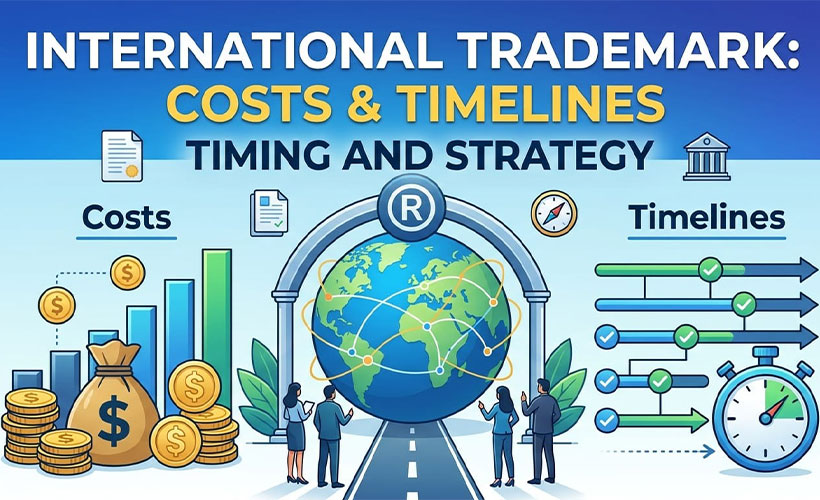
8. Costs and Timelines
International trademark filings can be expensive, even under the Madrid System.
Costs depend on:
- Number of countries selected
- Number of trademark classes
- Local attorney fees
- Objections and oppositions
Although the Madrid System reduces duplication, expenses increase significantly when multiple countries are involved.
Timelines also differ from country to country.
While WIPO processing is relatively fast, examination speed depends entirely on individual trademark offices. Some countries process applications quickly, while others may take much longer.
Businesses should therefore approach international trademark filing with realistic expectations regarding cost and timelines.
9. Conclusion
International trademark protection is not only a legal requirement but also an important business strategy for companies planning global expansion.
The main challenge is not understanding trademark law itself, but managing protection across different countries with different legal standards and procedures.
Businesses that operate internationally should address trademark protection at an early stage rather than waiting for disputes to arise.
A proactive and jurisdiction-specific approach is always more effective and cost-efficient than reacting to legal problems after they occur.
Proper planning, timely filings, and careful selection of jurisdictions can help businesses protect their brands successfully in international markets.