
SUMMARY JUDGMENT IN IPR: FASTER RELIEF, SMARTER LITIGATION - BY: AKHIL G. KRISHNAN
1. What’s Changed?
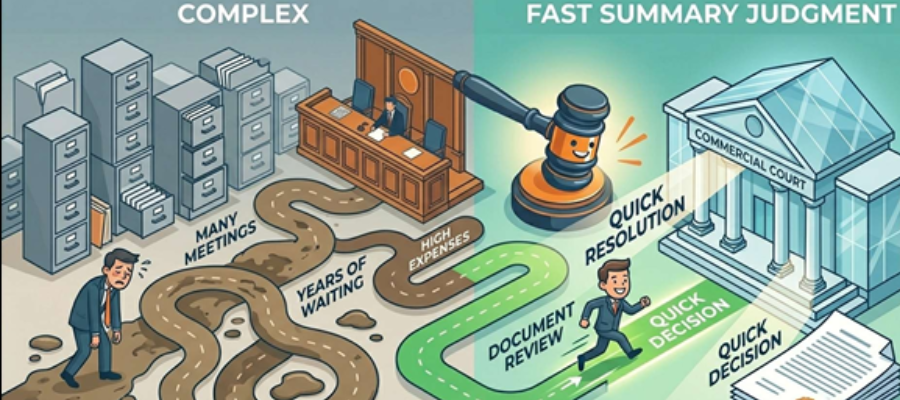
For a long time, commercial litigation in India followed a familiar path. Once a dispute was filed, it would proceed through pleadings, discovery, evidence, and only then reach final adjudication after a full trial. Even in cases where the outcome appeared relatively clear on the documents, the matter would still be required to go through the entire procedural cycle. That approach has now materially shifted.
With the introduction of Order XIII-A of the Code of Civil Procedure through the Commercial Courts Act, 2015, courts are no longer bound to mechanically carry every commercial dispute to trial. At the threshold stage itself, the court is empowered to examine whether the case actually requires a full trial or whether it can be decided on the basis of admitted facts and documentary material.
The underlying judicial question has become more direct. Is there a “real triable issue”, or is the dispute being prolonged without legal necessity?
The shift is procedural in form but substantive in impact. If the record is sufficient to decide the dispute, the court is no longer required to wait for a full trial to reach that conclusion.
2. The Rule in Simple Terms
The principle behind summary judgment is grounded in judicial efficiency and proportionality. A court may dispose of a commercial dispute at an early stage if it concludes that one party has no real prospect of succeeding on the claim or defence, and there is no compelling reason to proceed to a full trial. Both conditions must coexist. The expression “no real prospect” is not synonymous with a weak or arguable case. It refers to a situation where the claim or defence lacks substantive legal or factual foundation, such that even a full trial would not reasonably alter the outcome.
At the same time, the court assesses whether a trial would serve any meaningful purpose. If the dispute turns primarily on documents, admissions, or undisputed records, and does not require oral evidence or credibility testing, continuation of proceedings is considered unnecessary.
3. What the Supreme Court Says (2026)?
The Supreme Court, in its recent jurisprudence including Reliance Eminent Trading and Commercial Private Limited v. Delhi Development Authority, has clarified the contours of this power. The Court has emphasised a calibrated approach. Summary judgment is neither an automatic replacement for trial nor a provision to be applied sparingly in all cases. It is a structured mechanism designed to filter out disputes that do not require full adjudication.
The guiding principles can be summarised as follows:
- Courts should not undertake a detailed evidentiary evaluation at this stage
- Courts must not avoid exercising jurisdiction where absence of merit is apparent on record
- A defence must be substantiated by material and not rest on bare assertions
The judicial expectation is clear. Courts are required to balance caution with decisiveness. Where a dispute is not genuinely triable, the court is expected to bring it to an early conclusion rather than allowing procedural prolongation.
4. How Courts Have Actually Used It?
The practical use of this provision, especially in intellectual property disputes, shows a consistent pattern. Courts are willing to act early when the record leaves little room for doubt.
- In Ahuja Radios v. A. Karim, counterfeit goods bearing the plaintiff’s mark were found during inspection, and the defendant admitted that the products were not genuine. Once this admission was on record, there was nothing left to examine. The court treated the defence as non-existent in substance and granted an injunction immediately.
- In Bharti Bhawan v. Shree Jee Prakashan, the defendant did not even enter the proceedings. The plaintiff’s documents stood unchallenged. In the absence of any real defence, the court relied on the record and decreed the suit without delay.
- A similar situation arose in Merck Sharp and Dohme Corp. v. Munish Thakur, where the defendant chose not to participate despite opportunities. The court treated this as a clear indication that no real defence existed and granted relief without trial. What makes this framework balanced is that it applies equally to both sides.
- In Campus EAI India Pvt. Ltd. v. Neeraj Tiwari, the defendants actively contested the claim and placed a technical expert report on record. The report demonstrated that there was no copying of software. The court accepted this evidence and dismissed the suit at the threshold itself, holding that the claim could not succeed. Even in matters that appear complex at first glance, courts have not stepped back.
- In Su-Kam Power Systems Ltd. v. Kunwer Sachdev, the dispute involved competing claims over ownership of a trademark between a company and its founder. Despite the complexity, the court examined the agreements and surrounding material and concluded that a trial would not add any real value to the decision-making process. The matter was therefore decided early.
These decisions point to one clear trend:
Courts are no longer asking how complicated a dispute sounds. They are asking whether the record already answers it.
5. When It Will NOT Apply?
Despite its wide utility, summary judgment is not intended to replace trial in all commercial disputes.
Courts will refrain from applying this mechanism where:
- The dispute involves serious contested questions of fact requiring oral evidence
- Credibility of witnesses is material to adjudication
- The matter involves technical or expert issues requiring cross-examination
- The documentary record is incomplete, ambiguous, or disputed in material particulars
For instance, disputes involving fraud requiring detailed fact-finding, complex valuation issues, or heavily contested performance obligations will typically require a full trial.
The guiding principle remains judicial caution. If adjudication depends on evidence testing rather than document clarity, trial is indispensable.
6. What This Means for You?
The introduction and increasing use of summary judgment has materially altered litigation strategy in commercial disputes. For plaintiffs, the expectation is now front-loaded preparation and documentary precision. A well-supported case can result in early adjudication without prolonged trial.
For defendants, the threshold for resistance has increased significantly. A defence must be specific, substantiated, and supported by material at the earliest stage. Bare denials or delay tactics are increasingly ineffective and may result in adverse outcomes at the threshold. The litigation ecosystem now rewards clarity, documentation, and early legal
preparedness.
7. Conclusion
Summary judgment has reshaped the procedural architecture of commercial litigation in India. Courts are increasingly willing to decide cases at the threshold where the material on record is sufficient to reach a definitive conclusion. This has reduced avoidable trials and accelerated outcomes in appropriate cases.
The practical effect is significant. Strong cases are resolved faster. Weak or unsupported defences are filtered out early.
The most important shift is conceptual. In many commercial disputes today, finality is no longer reserved for the end of trial. It is often determined at the very beginning of the proceedings. The real shift is this: The outcome of a case is no longer reserved for the end of trial. In many matters today, it is decided at the very beginning.