
Patent in India: Complete Guide to Protect Your Inventions (2026)
Meta Description: Learn everything about patents in India. Understand patent law, registration process, benefits, and legal protection for inventions with this SEO-friendly guide.
Introduction: Why Patents Are Important
In today’s innovation-driven economy, inventions and new technologies are key to business growth and competitive advantage. A patent provides legal protection to inventors, granting them exclusive rights to their invention for a specified period.
Patent protection prevents others from making, using, selling, or distributing your invention without your consent, ensuring that your creativity and investment are safeguarded.
Whether you are a startup, SME, or independent inventor, understanding the patent system in India is essential to protect and monetize your innovations.
What is a Patent?
A patent is a legal right granted by the government to an inventor for a new, useful, and non-obvious invention. The inventor gets exclusive rights to use, sell, license, or commercialize the invention for a specific time.
In India, patents are governed by the The Patents Act, and the Controller General of Patents, Designs and Trademarks oversees the registration and enforcement of patents.
Types of Patents in India
-
Product Patent – Protects a new product or composition of matter.
-
Process Patent – Protects a new method or process of creating a product.
-
Design Patent (Industrial Design) – Protects the ornamental or aesthetic aspects of a product.
-
Plant Patent – Protects new varieties of plants.
Key Criteria for Patentability
For an invention to be patentable in India, it must meet the following conditions:
-
Novelty – The invention must be new and not published or publicly known.
-
Inventive Step (Non-Obviousness) – It must involve a unique solution that is not obvious to a skilled professional.
-
Industrial Applicability – The invention must be capable of being manufactured or applied in industry.
-
Non-Exclusion Criteria – Certain inventions like abstract ideas, scientific theories, or methods of agriculture may not be patentable under Indian law.
Benefits of Patent Registration
1. Legal Protection Against Infringement
Patents allow inventors to take legal action against unauthorized use or duplication.
2. Exclusive Commercial Rights
Patents provide exclusive rights to use and license your invention, creating potential revenue streams.
3. Business Valuation and Investment
Patents are intangible assets, enhancing company valuation and attracting investors.
4. Encouragement for Innovation
Patents incentivize inventors to continue innovating by protecting their intellectual property.
5. Licensing and Collaboration
Patents enable inventors to license their technology or collaborate with other businesses without losing ownership.
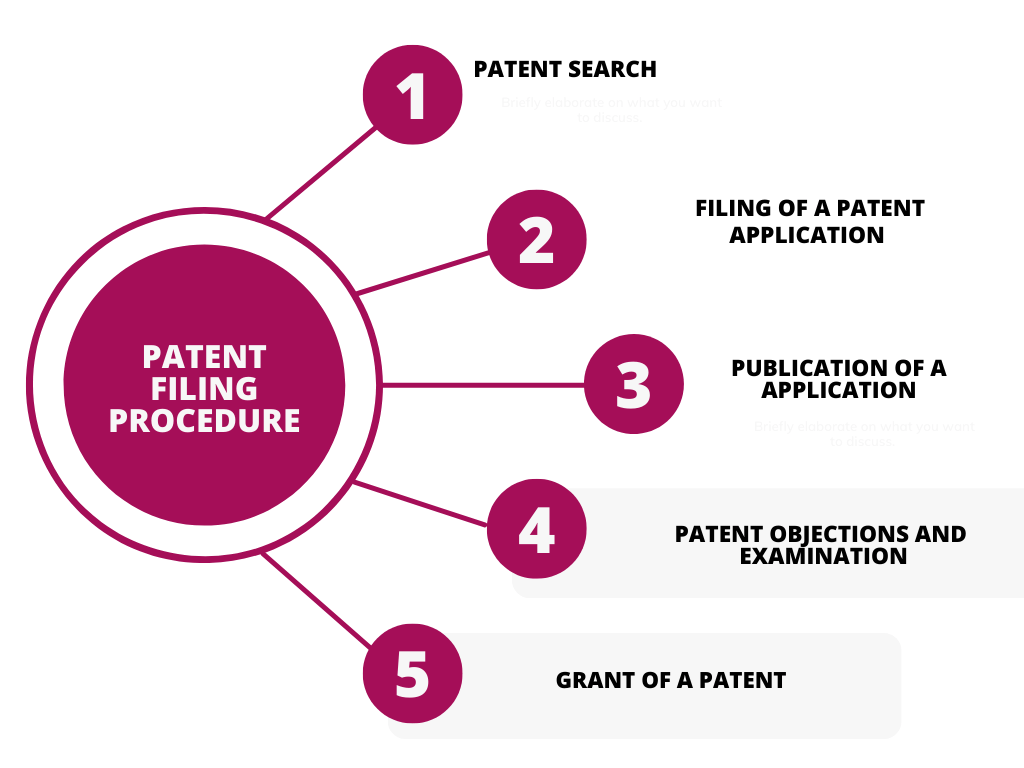
Step-by-Step Patent Registration Process in India
Step 1: Patent Search
Conduct a comprehensive patent search to ensure your invention is novel and does not conflict with existing patents.
Step 2: Filing the Patent Application
-
Submit your patent application online or offline to the Patent Office of India.
-
Required details:
-
Title and abstract of invention
-
Complete description and claims
-
Drawings or diagrams (if applicable)
-
Applicant and inventor details
-
Step 3: Publication
After 18 months, the patent application is published in the Patent Journal, allowing public objections.
Step 4: Request for Examination
-
A request for examination must be filed within 48 months from the filing date.
-
The examiner evaluates novelty, inventive step, and industrial applicability.
Step 5: Examination Report and Compliance
-
If objections arise, the applicant must respond and amend the application if required.
Step 6: Grant of Patent
-
Once the application complies with all requirements, the patent is granted and published in the Patent Journal.
-
Patent protection lasts for 20 years from the filing date.
Common Mistakes to Avoid in Patent Filing
-
Filing without a thorough patent search
-
Lack of proper documentation and drawings
-
Delaying the request for examination
-
Not responding to office objections promptly
-
Disclosing the invention publicly before filing
Avoiding these mistakes ensures smoother registration and stronger protection for your invention.
Role of a Patent Attorney
While patent filing can be done individually, an experienced patent attorney helps to:
-
Draft precise patent claims
-
Conduct detailed patentability searches
-
Handle office objections
-
Manage licensing and infringement cases
Hiring a professional ensures your patent filing is EEAT-compliant (Experience, Expertise, Authoritativeness, Trustworthiness) and legally robust.
Patent Protection Strategies Post-Registration
-
Monitor Competitors – Track similar inventions in the market.
-
License Strategically – Monetize your patent through licensing deals.
-
Enforce Rights – Take legal action promptly if infringement occurs.
-
Maintain Documentation – Keep detailed records of the invention and development process.
Patent in the Digital Era
-
Software Patents – India allows patents for software combined with technical innovation.
-
Biotechnology – Patents for genetically modified organisms or biological processes.
-
IoT and AI Inventions – Patent protection extends to technological innovations in emerging fields.
Digital monitoring tools can detect unauthorized use and help enforce patent rights globally.
SEO and EEAT Considerations
-
Use keywords: “Patent India,” “patent registration process,” “protect invention,” “intellectual property.”
-
Provide step-by-step actionable guidance to demonstrate expertise.
-
Reference official sources like the Indian Patent Office for authority.
-
Include FAQs for better engagement and ranking.
-
Highlight practical examples and benefits for inventors.
Conclusion
Patent registration in India is a strategic move for inventors and businesses seeking to protect, monetize, and legally enforce their innovations. A registered patent:
-
Secures exclusive rights
-
Enhances business valuation
-
Provides legal protection against infringement
-
Encourages continuous innovation
For inventors, startups, and enterprises, understanding the patent process and leveraging professional guidance ensures that your invention remains secure, profitable, and recognized.
Protect your innovation today—patent your invention and secure your competitive edge.
FAQs
Q1. How long does patent registration take in India?
Typically 3–5 years, depending on examination and objections.
Q2. How long is patent protection valid?
20 years from the filing date.
Q3. Can software be patented in India?
Yes, if it involves a technical solution and innovation beyond a business method.
Q4. Can patents be renewed after 20 years?
No, patents expire after 20 years and enter the public domain.
Q5. Can startups register patents for free?
Government fee structures for startups are reduced to encourage innovation.